

Ramesses II statues have surfaced in Egypt's Nile Delta after a farmer found an inscribed stone block while tilling his fields. The carved block, unearthed in front of the farmer's home in Behbeit El Hagar, prompted a rescue excavation that revealed the remains of two colossal royal statues — one identified as the 3,000-year-old pharaoh Ramesses II, the other believed to be him as well. Egypt's Supreme Council of Antiquities announced this week.
A carved stone block stops a routine day in the fields
The discovery began with a farmer, Khaled El-Shahat Khalil, working land in front of his home in Behbeit El Hagar, a village in Gharbia province north of Cairo. While tilling the soil, his tools caught on a stone block covered in carvings. Rather than ignoring it or treating it as farm debris, he reported it to the local antiquities inspectorate, which confirmed the block was ancient. Egypt's Supreme Council of Antiquities then dispatched a specialist team to carry out a rescue excavation — the kind of dig launched when something surfaces unexpectedly and must be recorded and protected before it is lost.
Fathy and Gharbia Governor Alaa Abdel Moaty later visited Khalil in his village, and he and his wife received a certificate of appreciation and an Umrah pilgrimage to Mecca, according to Turkiye Today.
A 1.6-metre head, a second statue, and a pink granite block
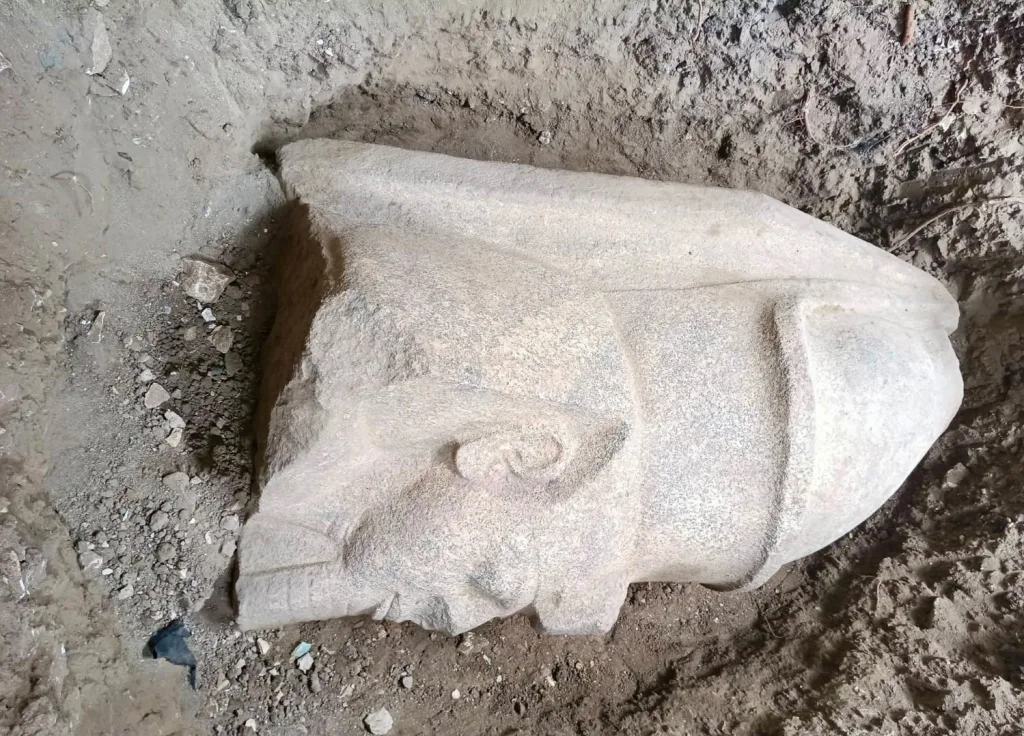
The first and most striking find was a stone head of Ramesses II standing about 1.6 metres tall, showing the king wearing the double crown of Upper and Lower Egypt — the symbol of rule over a unified Egypt. Part of the statue's back pillar also survived, carrying the king's Horus name, Hor Ka Nakht Mery Maat. From the head's scale, archaeologists estimate the complete monument, including its base, once stood about 8.5 metres tall — nearly 28 feet, taller than a two-story house.
Nearby, the team uncovered the surviving section of a second royal statue measuring about 2.4 metres. Its legs and base are missing and the upper part of its striped nemes headdress is damaged, but its face remains clearly visible and in good condition. Because its facial features closely resemble those of the first statue, researchers believe it also depicts Ramesses II, though study continues.
About one metre away lay a 1.3-metre block of pink granite bearing fragments of hieroglyphic inscriptions, including two royal titles: "Nesu Beti," meaning King of Upper and Lower Egypt, and "Sa Ra," meaning Son of Ra.
Why Behbeit El Hagar keeps giving up its secrets
The find spot adds to the intrigue. Behbeit El Hagar — a name meaning "the stones" — is already known for the remains of a major temple dedicated to Isis, built nearly 900 years after Ramesses II's reign (about 1279 to 1213 BC). The village has long yielded granite architectural blocks, and the new statues deepen evidence of the area's importance in ancient Egypt. Ramesses II, one of the most powerful rulers of Egypt's New Kingdom, is frequently associated with the unnamed pharaoh of the biblical Book of Exodus, which has only added to the discovery's global attention.
Supreme Council of Antiquities secretary-general Hisham El-Lithy said archaeological excavation and study would continue, aiming to establish how the statues relate to one another and to the site's ancient buildings. The finds are still being studied, and archaeologists say further work could reshape understanding of royal architecture and cult practice in the Nile Delta.
The takeaway is a quiet one: a single responsible decision — reporting a strange stone instead of moving on — opened a window into a world buried for more than 3,000 years. The farmer's field may yet hold more of it.
Music in this post's reel: Kevin MacLeod - Lightless Dawn (incompetech.com), licensed under CC BY 3.0
Sources: Egyptian Gazette · Gulf News · New York Post · Turkiye Today