

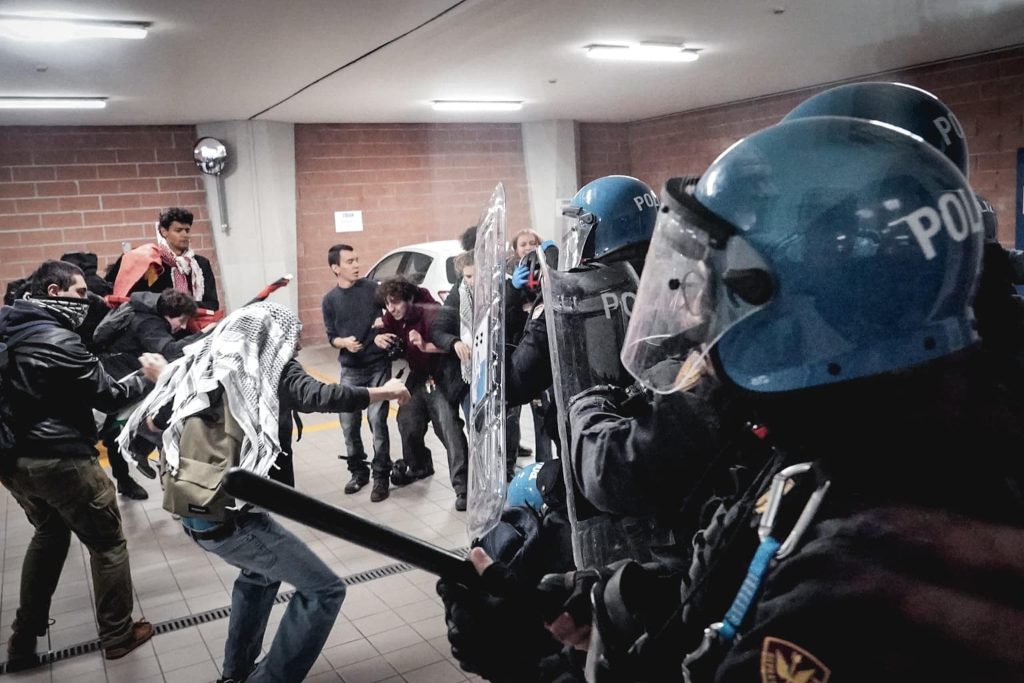
Italy's nationwide "No Meloni Day" student protests turned violent on October 16, 2026, as demonstrators clashed with police in Turin, Genoa, Venice, Padua, Treviso and Rome. The day of action against Prime Minister Giorgia Meloni's government drew thousands of students and teachers — organizers claimed more than 400,000 across the country — in marches that began peacefully before turning into street confrontations.
What happened on No Meloni Day
In Turin, the epicenter of the unrest, masked protesters hurled petrol bombs, rocks and firecrackers at officers, who answered with water cannons and tear gas in the central Piazza Castello. Footage showed students rocking a police van in an attempt to flip it, and a street sign was set ablaze. The violence followed days of school occupations in the city, with around 20 high schools occupied and masked youths smashing windows and discharging fire extinguishers inside. A 17-year-old was arrested as investigators examined whether some of those involved were outsiders who joined the protests.
In Rome, marchers moved from the Esquilino district toward the Education Ministry in Viale Trastevere, where they threw firecrackers and smoke bombs at the heavily guarded building and demanded a meeting with Education Minister Giuseppe Valditara. American and Israeli flags were burned along the route. Organizers put the Rome turnout at about 20,000. Similar clashes broke out in Genoa, Venice, Padua and Treviso, where protesters targeted right-wing figures with slogans, banners and eggs thrown at politicians' portraits. Turin teachers formed a human chain between students and police to try to prevent confrontations; it did not hold. Authorities said three minors were arrested for aggravated resistance and more than 50 others were identified for possible legal action. At least one teacher, a school staff member and a Carabinieri officer were injured in the Turin incidents.
Why students are protesting
The protesters' core demand is more investment in Italy's education system. Crowds chanted "Money for schools, not for war!" and "Fewer weapons, more rights!", and student spokespeople pointed to chronic underfunding, crumbling classrooms and the rising cost of living. Organizers also cited opposition to increased military spending and a controversial decree affecting migrant students. Beyond Education Minister Valditara, protesters targeted politician Roberto Vannacci with slogans and effigies.
The Italian movement is explicitly linked to France's ongoing youth unrest — now in its fourth week, described as the country's biggest youth protest movement in decades. Hundreds of French high schools have been blockaded, and more than 6,000 minors have been taken into custody since mid-September. One Italian student told La Stampa the Italian protests were held in solidarity with the French schools: "Our protest is the same one we've been waging for months: money not for war, but for education." A further wave of protests is planned for October 17, coinciding with a CGIL national strike, with the Student Network describing its goal as "permanent mobilization."
The government's response
Prime Minister Meloni condemned the violence while distinguishing it from legitimate demonstration. "I am always happy when there is mobilization," she said, adding that "a different thing is violence, the paper bombs, the attacking of law enforcement." She also criticized opposition leaders for what she described as a muted response to the unrest. Interior Minister Matteo Piantedosi praised the police for handling the day with "firmness, professionalism, and balance, even in the face of unprovoked aggression and violence."
Education Minister Valditara went further, calling the scenes outside his ministry "political hooliganism" rather than legitimate democratic dissent, and condemning the Rome actions as an attack on state institutions. He said the government would seek compensation for the damage. Turin mayor Stefano Lo Russo defended the right to demonstrate while urging students to "isolate the hooligans": "Demonstrating and defending one's ideas is a fundamental right that must always be respected and protected," he said, adding that violence and damage to public property were unacceptable.
What happens next is uncertain. With another day of strikes already scheduled and organizers promising sustained pressure over education reform, the confrontation — between a generation demanding investment in its schools and a government condemning street violence — shows no sign of easing.
Watch: thousands of students take part in nationwide protests across Italy
Music in this post's reel: Kevin MacLeod - Volatile Reaction (incompetech.com), licensed under CC BY 3.0
Sources
- The Sun — "Thousands of masked teens clash with riot cops and hurl petrol bombs & firecrackers as school riots spread to Italy"
- Archyde — "Thousands of Students Protest Across Italy in 'No Meloni Day' Demonstrations"
- anews — "Italian students stage protests against government education policies"
- Linksgraph/Il Messaggero — "Rome student protesters throw firecrackers at education ministry"