

The Razer Blade 16 (2026) squeezes NVIDIA's flagship RTX 5090 Laptop GPU and Intel's Panther Lake Core Ultra 9 386H into the thinnest Razer Blade ever — 14.9 mm — and reviewers are calling it the most desirable gaming laptop money can buy. With an average review score above 90%, near-13-hour tested battery life, and a brighter 240 Hz OLED display, Razer has refined its flagship thin-and-light without raising the starting price. Here's our full breakdown of the specs, price, benchmarks, pros and cons.
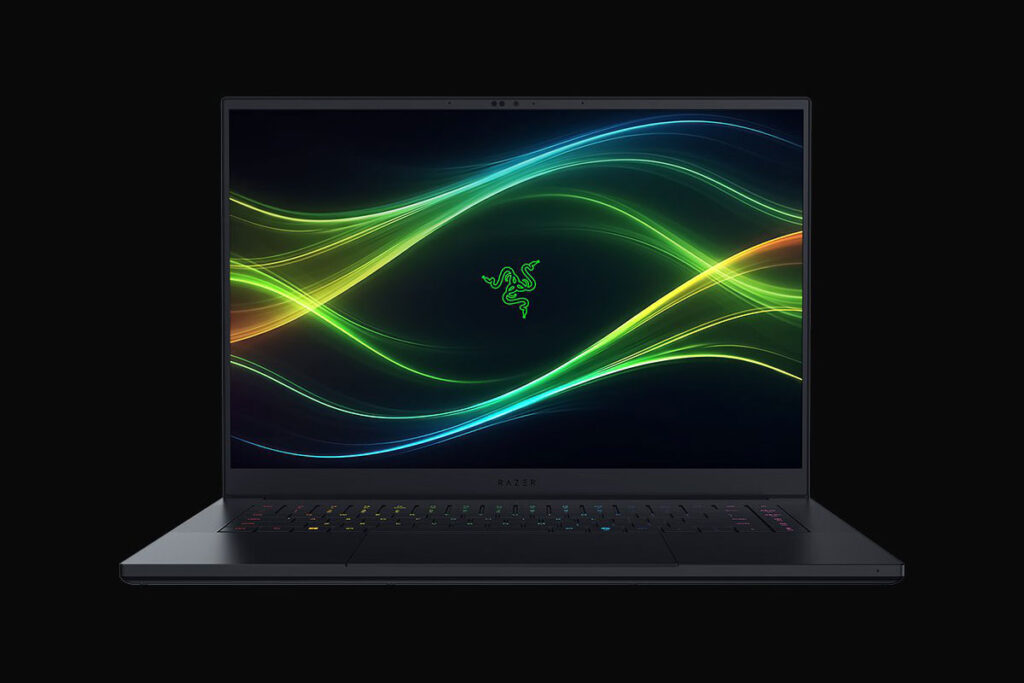
Razer Blade 16 (2026) specs
| Spec | Razer Blade 16 (2026) |
|---|---|
| Display | 16″ QHD+ 2560×1600 OLED, 240 Hz, 0.2 ms, 1000-nit HDR (DisplayHDR TrueBlack 1000), Calman-verified, 100% DCI-P3 |
| Processor | Intel Core Ultra 9 386H (Panther Lake, 16 cores/16 threads, up to 4.9 GHz P-core), NPU 5 with 50 TOPS |
| Graphics | NVIDIA GeForce RTX 5090 Laptop GPU, 24 GB GDDR7, up to 160 W TGP |
| RAM | 32 GB LPDDR5X-9600 soldered (64 GB option) |
| Storage | 1 TB or 2 TB PCIe 4.0 SSD (dual M.2 slots, user-expandable) |
| Ports | Thunderbolt 5, Thunderbolt 4, 3× USB-A 3.2 Gen 2, HDMI 2.1, full-size SDXC reader, 3.5 mm audio |
| Wireless | Wi-Fi 7, Bluetooth 6.0 |
| Battery | 90 Wh; up to ~13 hours productivity / ~15 hours video playback (Razer) |
| Chassis | 14.9 mm thin, ~2.12 kg, CNC aluminium unibody, six-speaker system |
| Webcam | 1080p + IR (Windows Hello) |
| OS | Windows 11 Home |
| Price | From ~$2,300 (AMD/RTX 5060) to ~$4,999.99 (Intel/RTX 5090); reviewed RTX 5090 config ~$4,900 |
Design & display
The 2026 Blade 16 keeps the redesign that debuted last year — CNC-milled aluminium, a per-key RGB keyboard, and a chassis just 14.9 mm thick, making it the thinnest Blade Razer has ever built. Reviewers at Notebookcheck, Gizmodo and Can Buy or Not all praise the premium build, and the six-speaker sound system gets high marks — though Gizmodo calls the trackpad bad and the sound "middling".
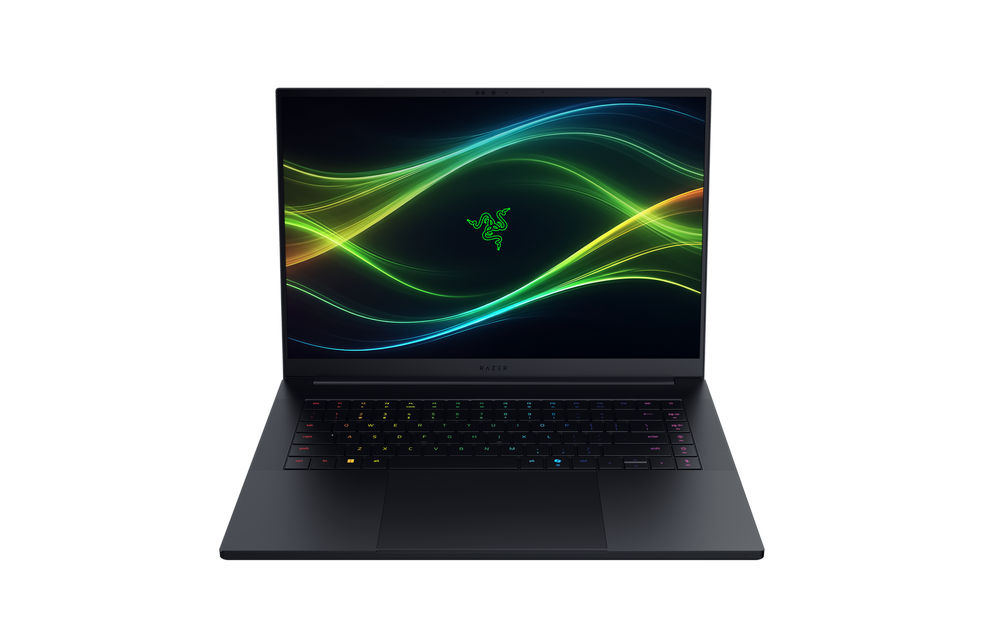
The headline upgrade is the display: a 16-inch 2560×1600 OLED at 240 Hz that is 100 nits brighter than last year's panel, now carrying a VESA DisplayHDR TrueBlack 1000 rating (up to 1,100 nits peak HDR, ~470 nits SDR). Every unit is Calman-verified and factory colour-calibrated, and Notebookcheck's tests confirm excellent out-of-the-box colour accuracy — PC Gamer calls it "one of the best OLED panels on the market".
Performance & benchmarks
Intel's Panther Lake Core Ultra 9 386H (16 cores, 16 threads, up to 4.9 GHz boost) replaces last year's AMD-exclusive setup on the Intel models, paired with the RTX 5090 Laptop GPU at up to 160 W TGP and 32–64 GB of LPDDR5X-9600 memory. Notebookcheck's review (87.7%) notes that Panther Lake brings substantial gains in battery efficiency and gaming stability, though raw multi-core CPU throughput still trails Apple Silicon and Intel/AMD HX-series parts.
Where the Blade 16 (2026) earns its flagship badge is GPU performance per millimetre. Notebookcheck found that in GPU-bound titles like Cyberpunk 2077 at QHD and Baldur's Gate 3, the 160 W RTX 5090 rivals heavier, hotter 175 W RTX 5080/5090 machines such as the Lenovo Legion Pro 7 and the ASUS ROG Scar 16 — essentially desktop-class gaming from a chassis barely thicker than an ultrabook. The on-die NPU 5 delivers 50 TOPS, comfortably clearing the bar for next-generation Copilot+ AI features.
Battery & thermals
This is where Panther Lake pays off. Razer claims up to 13 hours of productivity and 15 hours of video playback from the 90 Wh battery, and Tom's Hardware's testing found nearly 13 hours of web browsing — remarkable for a 16-inch RTX 5090 gaming laptop. Gizmodo reports it "lasts most of the workday", while Can Buy or Not notes "significantly better battery life in non-gaming scenarios". Under sustained gaming loads, the Blade still runs hot and loud — the cost of 160 W in 14.9 mm — but Balanced mode keeps it quiet enough for daily work.
Price & availability
US pricing: the Blade 16 (2026) lineup starts at $3,499.99 for the Intel Core Ultra 9 386H / RTX 5080 / 32 GB configuration (GamesRadar), with RTX 5080 models at $3,999.99, the RTX 5090 / 32 GB / 2 TB configuration at $4,899.99, and a maxed-out 64 GB model at $4,999.99 — roughly matching last year's MSRP despite the RAM shortage. Cheaper AMD-based variants with an RTX 5060 start around $2,300. The laptop is available now from Razer and major retailers.
Pros and cons
Pros:
- RTX 5090 (160 W) in the thinnest Blade ever — desktop-class gaming per millimetre
- Superb 240 Hz OLED: 1,000-nit HDR, Calman-verified, factory calibrated
- Excellent battery life for a gaming flagship (~13 hours web browsing tested)
- Strong connectivity: Thunderbolt 5, Wi-Fi 7, full-size SD reader, HDMI 2.1
- 50 TOPS NPU for next-gen Copilot+ AI features
Cons:
- Gag-worthy price — around $4,900 for the reviewed RTX 5090 config
- Soldered RAM can't be upgraded later (SSD can)
- Runs hot and noisy under sustained gaming loads
- Glossy screen and a relatively heavy power brick
- Subpar trackpad and middling speakers for the price (per Gizmodo)
Where to buy
- Razer Blade 16 (2026) — official Razer store (configurator with all CPU/GPU/RAM options)
- Newegg — Razer Blade 16 listings (retail pricing and availability)
- Amazon — Razer Blade 16 (2026) search (third-party seller pricing)
Verdict
The Razer Blade 16 (2026) is the gaming laptop you buy when money is secondary to power-per-millimetre: a genuine RTX 5090 workstation-class machine in a 14.9 mm chassis that sips battery like an ultrabook and shows off one of the best OLED panels you can buy. At ~$4,900 for the flagship config, it's impossible to call a good value — the RTX 5080 model or a thicker rival like the ASUS ROG Scar 16 buys you similar frames for less. But for gamers, creators and professionals who want one machine that does everything and actually fits in a backpack, nothing else comes this close.
Watch: Is This the Ultimate Thin & Light Gaming Laptop? (Razer Blade 16 2026 Review) — Notebookcheck's in-depth video review with real-world fan-noise samples, 4K DaVinci Resolve playback tests and 1440p gameplay benchmarks.
Sources: Notebookcheck, Gizmodo, TweakTown, GamesRadar