

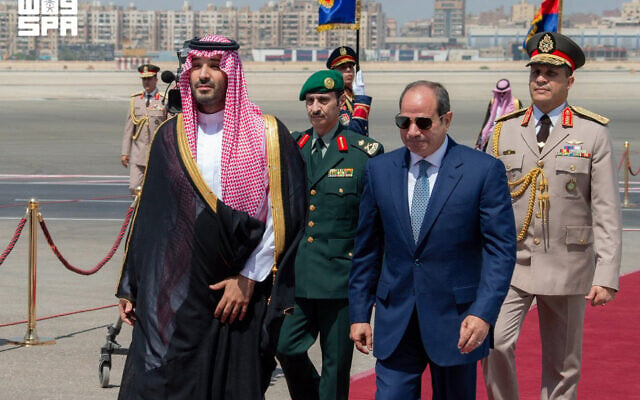
Egyptian President Abdel Fattah al-Sisi pledged on Saturday that Egypt would take "any measures necessary" to defend Saudi Arabia if the kingdom requests it, as Iran-aligned Houthi rebels escalate attacks on Saudi airports and oil facilities. The dramatic commitment — delivered at a graduation ceremony at the Egyptian Military Academy — marks Cairo's deepest involvement yet in the reignited Yemen conflict.
"We are speaking only about defense"
Sisi struck a careful balance in his remarks, insisting Egypt was not seeking a regional fight while making clear Cairo would not stand aside. "It is inconceivable that we would allow Saudi Arabia, its security or stability to be harmed," he said. "I'm not talking about fighting anyone or attacking anyone... We are speaking only about defense."
The president said any Egyptian deployment would require parliamentary approval, and asked lawmakers to convene an emergency session to grant authorization in advance. Parliament responded within hours, announcing a plenary session for 1 p.m. local time on Sunday — though it did not disclose the agenda.
Why Egypt is moving now
The trigger is a sharp escalation by Yemen's Houthis. In recent days the rebels have attacked Riyadh's King Khalid International Airport and state oil giant Saudi Aramco, amid renewed fighting with Saudi-backed forces of Yemen's internationally recognized government following the collapse of a truce. An airport attack last week killed 13 people — the deadliest in over a decade. On Saturday, Saudi Arabia said it had intercepted four drones over Riyadh, the Eastern Province and the south.
The Houthis have also blockaded the Bab el-Mandeb Strait, squeezing energy exports, while Iran presses its own blockade of the Strait of Hormuz. For Egypt, the stakes are economic as well as strategic: Foreign Minister Badr Abdelatty said last month that the Suez Canal has lost about $11 billion in revenue since the Houthis began attacking commercial vessels.
What happens next
On Sunday, after a National Defence Council meeting chaired by Sisi and attended by the parliamentary speaker, prime minister and army chief, the presidency said Egypt "will provide Saudi Arabia with all necessary and possible forms of support to defend its security and stability, protect its resources, territorial integrity and Islamic holy sites."
Under Egypt's constitution, sending forces abroad on a combat mission requires the council's consultation and approval from two-thirds of parliament. MP Mostafa Bakry, a lawmaker close to the state, said the council had approved sending forces on "a defensive mission" — while the Houthis warned Cairo against intervention.
Sisi said Egypt would act in line with guidance from King Salman and Crown Prince Mohammed bin Salman, who visited Cairo on September 15 to discuss Red Sea security. Egypt joined the Saudi-led coalition that intervened in Yemen in 2015, though it has played a limited combat role. The two countries are close strategic and economic partners — Gulf states provided Egypt with billions of dollars in aid, central-bank deposits and investments after the 2013 ouster of Mohamed Morsi.
In the same speech, Sisi, 71, also announced he would not seek to remain in office when his term expires in 2030, calling the matter "completely settled" and saying the constitution "would not be touched."
The takeaway: Egypt is positioning itself as Saudi Arabia's military backstop just as the Yemen war reignites — a defensive pledge with parliamentary backing that could draw one of the region's largest armies into the conflict, and a signal that Cairo's patience with Houthi attacks on Red Sea shipping has run out.
Watch: Hindustan Times video report on Egypt pledging to defend Saudi Arabia and Sisi's parliament-authorization request (published October 18, 2026).
Music in this post's reel: Kevin MacLeod - Lightless Dawn (incompetech.com), licensed under CC BY 3.0
Sources: Reuters, Reuters, The Times of Israel, Al Jazeera.